


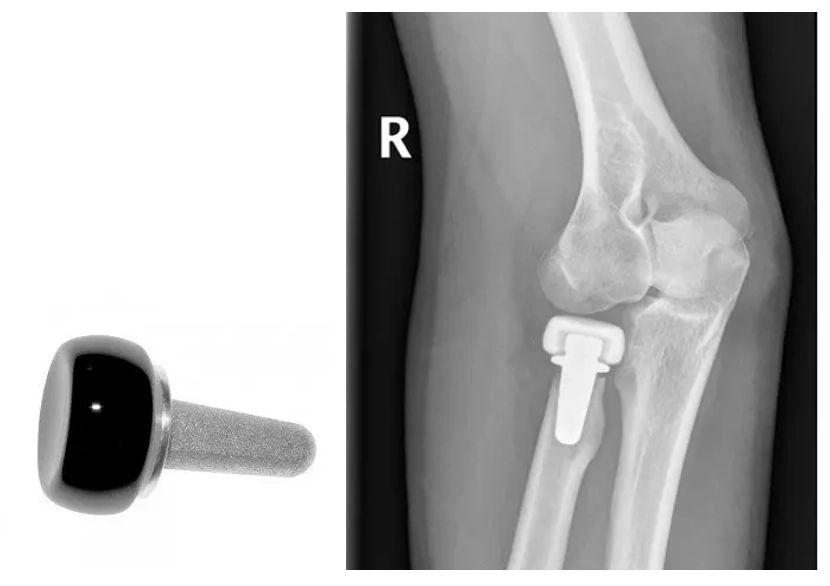
Radial Head Replacement is a surgical procedure in which a damaged or fractured radial head (the top part of the radius bone near the elbow) is replaced with an artificial implant. This procedure is usually recommended when the radial head is severely fractured, irreparable, or associated with elbow instability.
What is the Radial Head?The radial head is the uppermost part of the radius bone in the forearm that forms part of the elbow joint. It allows for smooth rotation of the forearm and helps stabilize the elbow. Damage to this area can lead to pain, limited motion, and instability.
Indications for Radial Head ReplacementRadial head replacement may be recommended in the following situations:
1Comminuted fractures (multiple fragments of the radial head that cannot be repaired)
2Failed previous surgeries or non-healing fractures
3Elbow instability due to ligament injuries
4.Arthritis or post-traumatic degeneration of the radial head
Symptoms of Radial Head InjurySevere pain on the outer side of the elbow
Swelling and bruising around the elbow joint
Limited range of motion, especially rotation of the forearm
Weakness in gripping or lifting objects
Clicking or popping sounds during movement
The Procedure1.Anesthesia – The patient is given general or regional anesthesia.
2.Surgical Approach – The surgeon exposes the damaged radial head through a small incision.
3.Removal of Damaged Bone – The fractured or arthritic radial head is removed.
4.Implant Insertion – A prosthetic radial head is inserted to restore normal joint alignment and function.
5.Closure and Immobilization – The incision is closed, and the elbow may be placed in a splint for initial protection.
Recovery and RehabilitationHospital stay is usually 1–2 days, depending on the complexity of the surgery.
Early physiotherapy is crucial to restore movement and strength.
Full recovery typically takes 6–12 weeks, but gentle exercises often begin within days after surgery.
Regular follow-ups ensure proper implant function and healing.
Benefits of Radial Head ReplacementPain relief from fracture or arthritis
Restoration of elbow stability and motion
Prevention of long-term complications like stiffness and deformity
Improved ability to perform daily activities
Possible ComplicationsInfection
Implant loosening or wear
Nerve or blood vessel injury
Limited range of motion
Persistent pain in rare cases
- Fracture Around The Shoulder
- Shoulder Arthroscopy
- Shoulder Impingement
- frozen Shoulder
- Shoulder dislocation
- Shoulder Joint Replacement
- Rotator Cuff Tear
- Biceps Tendinitis
- Calcific Tendinitis
- Carpal Injuries
- Reverse Shoulder Replacement Surgery
- Precover Redant Shoulder Location
- Elbow Replacement
- Elbow Arthroscopy
- Elbow Fracture
- Elbow dislocation
- Tennis Elbow
- Radial Head Replacement
- Wrist Scaphoid Nonunion
- Wrist Fractures
- Wrist Scaphoid Fractures
- Wrist Arthroscopy
- Rheumatoid Wrist
- Thumb Pain – 1st CMC Arthritis